Choosing between an infinity pool vs zero-edge pool is a defining decision for any premium architectural project.
The world of high-end water architecture features overlapping terms that often confuse discerning property owners.
This guide clarifies the distinct types of overflow pool systems to help you choose the ideal design.
Explore the quiet mechanics and structural choices that bring these perfect water edges to life. Let’s go!
What is an infinity pool? (vanishing-edge pool)
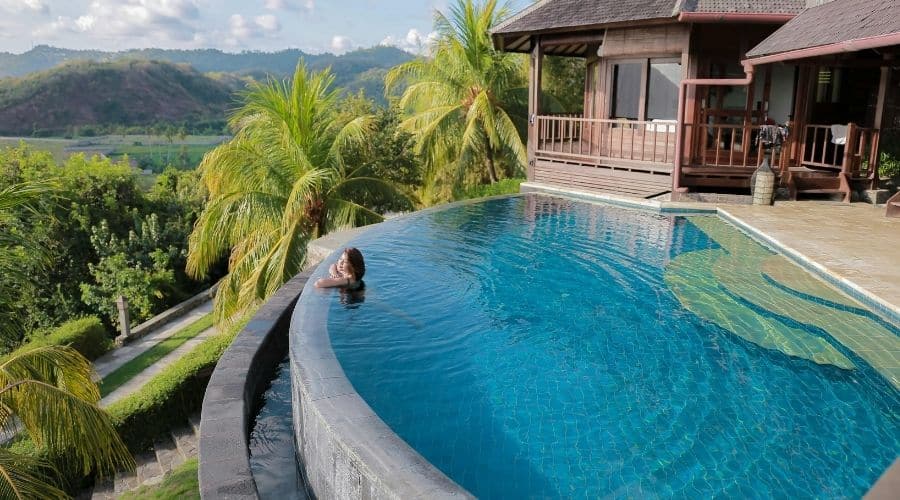
An infinity pool features one or more walls built slightly below the designated waterline.
Water gently sheets over this lowered section—the infinity pool weir—and drops entirely out of sight.
This creates the illusion of a disappearing edge pool blending into a sea, valley, or horizon view.
You will also hear this architectural feature referred to as a negative-edge pool.
➜ How the catch basin infinity pool system works
The overflowing water spills over the structural weir and drops into a hidden catch basin below.
Specialized pumps pull the water from this basin, send it through filtration and quietly return it to the main pool.
Understanding the zero-edge pool (deck-level pool)
A true zero-edge pool—or deck-level pool—is structurally distinct from a vanishing-edge design.
When comparing a negative-edge vs zero-edge pool, the visual destination of the water changes completely.
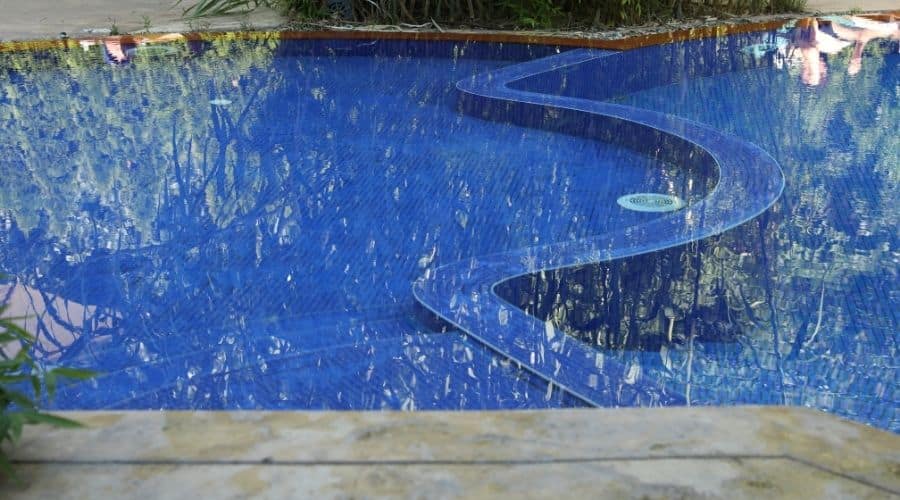
In a perimeter overflow pool, the water sits completely flush with the surrounding stone deck or coping.
The water constantly overflows across all four sides, creating a perfectly still, reflective mirror surface.
💡 Design note: do not confuse a zero-edge design with a zero-entry pool, which refers to a sloped, beach-style walk-in entry.
➜ The mechanics of a perimeter channel pool
The water overflows seamlessly into a slim, concealed perimeter channel slot built into the surrounding deck.
From there, gravity directs the water into a hidden balance tank before filtration systems pump it back up.
The knife-edge pool (Lautner edge pool)
The knife-edge pool represents the most refined and exacting variation of the classic deck-level pool design.
Conceived by architect John Lautner, the pool wall is cast to a sharp, hidden profile beneath the waterline.
Water flows into a slot so fine it is practically invisible, keeping the surrounding deck dry.
Achieving a flawless Lautner edge pool requires architectural tolerances measured to a fraction of a millimeter.
Deck-level pool vs conventional skimmer pool design
Traditional luxury properties often feature a standard skimmer pool, also known as a freeboard pool design.
In a freeboard pool, the waterline sits roughly 150 mm below the coping, utilizing wall-mounted skimmers.
While functional, a perimeter overflow pool skims the entire water surface at once for superior clarity and aesthetics.
The trade-off for this seamless look lies in the advanced engineering and structural complexity required.
| Feature | Infinity (negative-edge) | Zero-Edge (deck-level) | Knife-Edge (Lautner) | Freeboard (Skimmer) |
| Overflow sides | One or two sides | All four sides | All four sides | None |
| Visual effect | Horizon blend & drama | Still, flat mirror | Seamless liquid sheet | Standard waterline |
| Site requirement | Requires a slope/view | Flat, enclosed sites | Flat, architectural sites | Fits any terrain |
| Catch system | External catch basin | Perimeter slot channel | Fine concealed slot | Wall skimmers |
| Balance tank | Yes | Yes | Yes | No |
| Investment level | High | Higher | Highest | Standard luxury |
How to choose an edge by project typology
Selecting the ideal pool edge is guided entirely by the unique topography of your property.
The right choice respects the natural landscape, ensuring the final design feels completely integrated.
➜ For a sloped plot with an expansive sea or valley view, an infinity edge is the ideal choice.
Directing the structural weir toward the horizon creates a flawless visual connection with the scenery.
➜ Flat courtyards, rooftops or enclosed gardens with no view favor a deck-level pool or knife-edge design.
These styles deliver a captivating mirror effect perfectly suited for private, level spaces.
➜ If the project demands an absolute architectural statement, the knife-edge provides unmatched refinement.
It delivers the most meticulous, seamless detailing available in modern luxury swimming pool design.
➜ For secondary residences or highly practical luxury builds, a premium freeboard pool remains excellent.
It offers a beautifully finished, elegant solution with a simpler mechanical footprint.
In a Mediterranean villa with an infinity pool, designers often combine both worlds for a striking effect. The classic approach pairs an infinity edge facing the sea with deck-level detailing on the interior sides.
Conclusion
Selecting the proper edge design ensures your swimming pool integrates flawlessly with your property’s architecture.
💡 When executed with precision, the perimeter becomes invisible, leaving only a striking statement of luxury.
At GodoPools, we craft bespoke luxury swimming pool design solutions tailored to unique landscapes and premium standards.
Our team harmonizes advanced structural engineering with sophisticated aesthetics to bring your vision to life.
Talk to our specialist team today to design your bespoke pool.
Frequently asked questions (FAQs)
➜ Is a zero-edge pool the same as an infinity pool?
Not quite. An infinity pool overflows on one or two sides toward a view. A zero-edge (deck-level) pool overflows on all four and needs no view.
➜ Which edge type is most expensive?
The knife-edge (Lautner edge), because of the extreme precision and hidden detailing it demands.
➜ Do edge pools waste water?
No. The same water recirculates in a closed loop. You’ll lose a little more to evaporation, but nothing pours away.
➜ Can I have an edge pool on a flat site?
Yes, a deck-level or knife-edge pool is ideal for flat or enclosed plots. Infinity edges are the ones that need a slope or a view.